The Eye Exam
18th Jul 2024
The most accessible health exam which can be arranged relatively quickly is having your eyes checked.
It is done by an Optometrist who is a qualified healthcare professional who are trained to detect visual and eye health problems.
Also trained to supply spectacles, contact lenses and any specific devices to help with your vision if required. Another professional qualified to carry out these tasks is a Dispensing Optician.
There are various reasons why someone may seek to have an eye exam:
No problems but would like to know well how well they are seeing.
Vision changes are more noticeable.
Occupational requirements such as drivers (need to make sure their vision meets standards). Screen users where their employers are legally obliged to make provisions for their employees to have an eye exam at least every 2 years.
Your GP may request for you to have an eye exam for various reasons,
particularly requested when symptoms of headaches is reported.
Whatever the reasons to have an eye exam, here is what to expect.
Pre-Screening
Also known as the initial exam the following will be done.
Questions will be asked:
- Reason for your visit
- Are you a driver?
- Use Vdu, screens and/or digital devices and for how long.
- Hobbies
These are asked to assess your visual and lifestyle needs
Auto-Refractor
A machine that essentially measures the focal length of your eyes to estimate the power of your eyes. It will determine whether you are astigmatic (irregular eye curvature), hyperopic (long-sighted) or myopic (short-sighted).
Your eye pressure is measured (referred to as intraocular pressure). This test is carried out to detect Glaucoma and/or Ocular Hypertension.
Retinal Photography/OCT.
A photograph is taken as a record of the health of your eyes. This photograph shows the surface of the retina.
You may be offered at an extra cost to have a scan called OCT (Optical coherence tomography)which shows what lies in between the retinal layers. This test enables conditions such as macula degeneration to be detected much earlier.
Visual Fields
A test to check your peripheral vision. Not done on everybody, usually done on drivers, certain symptoms and done on request after the eye exam.
The Eye Exam
The Optometrist will take you into the eye exam room and sit you down on the test chair. In front of you will be the vision chart and beside will be the equipment to check your eyes. But first…
History And Symptoms
A set of questions will be asked to ascertain the reason for your visit.
You will be asked how is your vision and whether you struggle to see at any particular time.
You will also be asked if you suffer from headaches, double vision, see flashing lights and floaters.
Next will be questions on your general health, any medications taken, your ocular history, any eye surgeries, infections or injuries.
The last question will be family history, you will be specially asked if Diabetes and Glaucoma is in the family.
These questions are asked to enable to take into account of any side effects (particularly from medication) or any other factors which could be linked to your symptoms, findings and outcome.
Vision/Visual Acuity
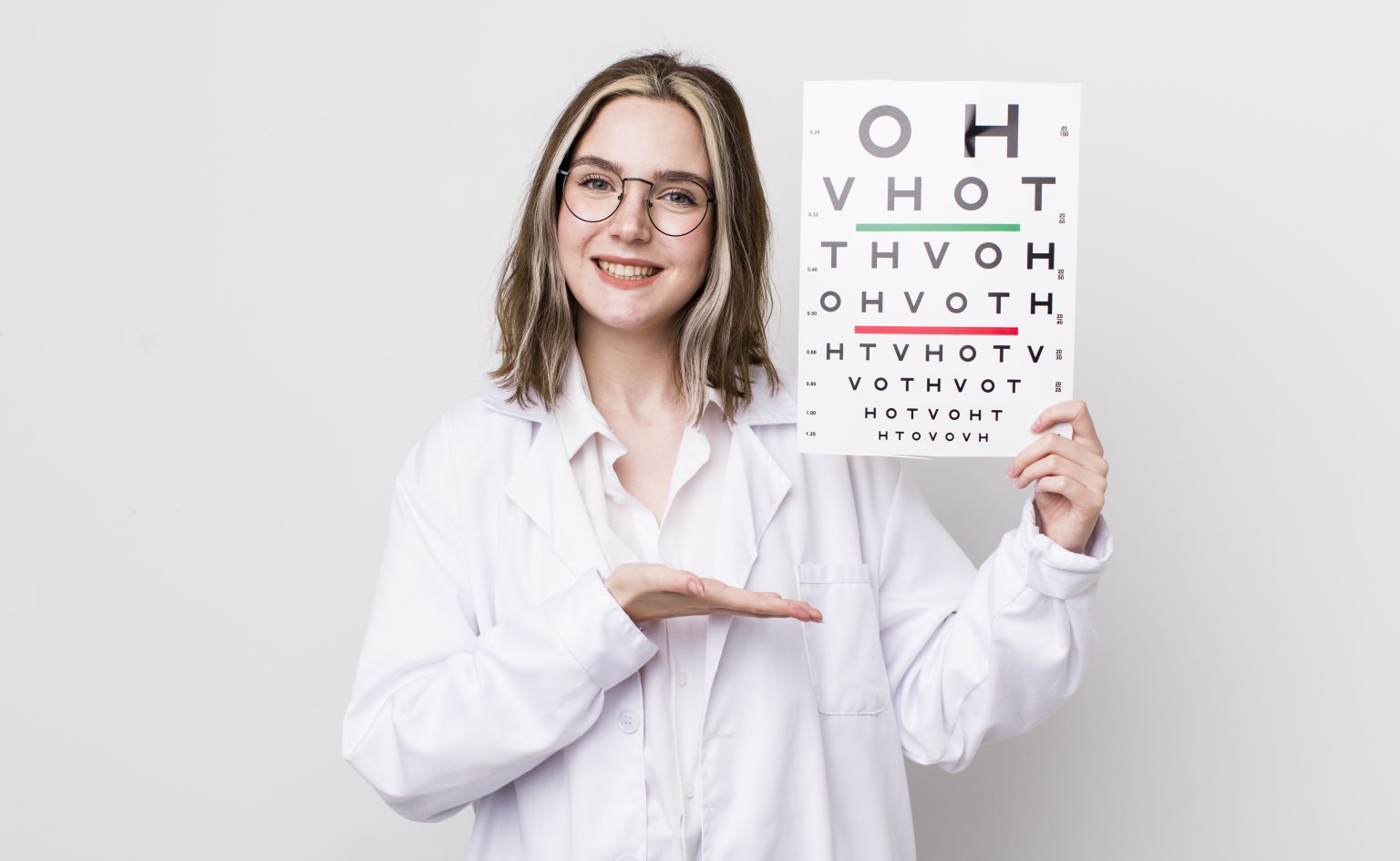
You will be asked to look at a chart with letters and read out the the lowest line of letter’s possible or you may be shown a row of letters to be read out and then the optometrist will show you another set of letters which will be smaller in size until the smallest possible.
One eye will be covered with an occluded, so it’s important that both eyes are kept open during this test. As shutting one eye can cause the other eye to focus, it’s important that both eyes are relaxed.
This is to measure how well you see in the distance. Vision is a measurement without correction. If you wear spectacles, then your ‘visual acuity’ will be measured.
Next, your near vision will be measured. This is done using a reading chart which consists of paragraphs of different-sized fonts ranging from N5(the smallest size print) to N48 (the largest size print). Again each eye will be measured at a time with one eye covered with an occluder. Both eyes need to be kept open during this check. Near vision is measured without spectacles. If you wear spectacles for near vision, then your ‘near visual acuity’ will be measured.
Cover Test
The muscle balance check. The purpose of this test is to determine if your symptoms are linked. It’s normally done at the same time as the vision checks using an occluder. In the distance, you will be shown a target at the appropriate size to look at and the optometrist will carry out the test. Also done at near vision using an appropriate target.
Depending on your vision, this may be done with spectacles worn. If double vision is reported, ocular motility may be done, where your eye muscles are assessed at certain directions of gaze.
Health Exam
The most important important part of the eye exam. The health of the structures of your eyes will be checked. On the anterior part, the eyelids, lashes, the conjunctiva and cornea. The central part, the anterior chamber, the lens and vitreous. The posterior part, the retina, blood vessels, the optic nerve and macula. Either the slit lamp, ophthalmoscope or both will be used. If the view of the retina is difficult, which could be due to small pupils and/or lens changes, then a dilated exam may be necessary. Your vision will be blurred for up to 12 hours. Regardless of the state of your vision, you should not drive or operate machinery.
The Refraction
Sometimes this is done before the health exam.
This test is now more frequently done using a phoropter, at times a trial frame and lenses may be used.
The measurements from the auto refractor are placed in the phoropter or trial frame or a retinoscopy may be performed where a torch is used to measure the light reflex from your pupils.
You will be asked to look at the test chart so further refinements are made to issue a spectacle prescription.
The Outcome
The Optometrist will talk you through the findings and advise whether spectacles are needed. Also, the health of your eyes will be discussed.
If spectacles are needed, recommendations will be made taking into account all the information and assessment results. The type of lenses, frames and if you’re suitable for contact lenses will be suggested if appropriate.
The Handover…
Covered next time!